Climate Change
Terrestrial Biodiversity
Pollution
Mountains, Glaciers, Tundra & Permafrost
Ecosystem Services
Climate Adaptation & Resilience
Water Quality
Toxic Pollutants & Hazardous Substances
AXA Chairs
France
2019.04.22
The Impact of Global Change on Mountains: Assessing the Threat to Nature’s Water Towers
From 2019 to 2025, Dr Dirk Schmeller, AXA Chair on Functional Mountain Ecology, documented the environmental changes occurring in mountain lakes. He highlighted a significant ecological crisis that endangers biodiversity, livestock, and the freshwater security of billions of people worldwide. Continue reading ahead to discover key insights and outcomes of this important research.
Mountain lakes provide freshwater to more than half the world’s population while supporting unique biodiversity adapted to extreme conditions. However, research reveals these seemingly pristine ecosystems are facing a devastating convergence of pressures that will fundamentally alter their ability to sustain life. The results of which will damage food security, climate stability and human health worldwide, while potentially triggering irreversible tipping points that degrade the global life-support system our planet represents. Dr. Dirk Schmeller, AXA Chair on Functional Mountain Ecology, documented the environmental changes occurring in mountain lakes – an environmental catastrophe that threatens biodiversity, livestock and the freshwater security of billions of people globally.
Ecological Threats
Dr Dirk Schmeller and his team detected 151 individual chemical compounds in Pyrenean lakes, with acute toxic levels found in 29% of studied sites. These include various PFAS (or “forever chemicals”), with known detrimental effects on living organisms – as well as cancerogenic molecules and endocrine disruptors. The highest toxicity, however, stems from insecticides like diazinon and permethrin, likely introduced through veterinary treatments of livestock as well as the use of insect repellents by tourists. At least one of these insecticides has been found across the full mountain range of the Pyrenees. Schmeller has shown that even in low concentrations, the combined toxicity eliminated crustacean communities in the most affected areas. Since these aquatic species play a vital role in filtering and cleaning water, their disappearance allows algae to spread with negative effects on the entire mountain ecosystem.
Moreover, pathogens are attacking amphibian populations with unprecedented severity; notably, chytrid fungi and the ranaviruses. These pathogens have already caused massive population declines in European amphibians and threaten global amphibian biodiversity – 41% are at risk of extinction. The spread of these pathogens is likely human driven and reinforced by the degradation of the aquatic habitat. Schmeller’s team also focused on the bacteria living on amphibian skin, known as the microbiote. Animals with diverse bacterial communities show enhanced protection against deadly fungal infections, but this natural defence system is degraded due to various anthropogenic impacts. A similar effect was seen in biofilms; the microbial communities that coat surfaces and create an interface on rocks, for example, in mountain lakes. While these microbial communities normally provide natural barriers against pathogenic organisms, five years of monitoring revealed significant shifts in biofilm composition, with beneficial microorganisms declining as potentially harmful ones increase.
Time for Action
Mountain ecosystems function as early warning systems for global environmental change, and the signals they are sending are deeply troubling. The findings from the Chair reveal they are under siege from multiple, synergistic threats that demand immediate understanding and response. The crisis unfolding in these remote lakes today foreshadows broader environmental challenges that will define the future of our planet’s life-support systems. Degradation represents not just an environmental tragedy but a direct threat to human water security and global biodiversity conservation. The window for effective intervention is rapidly closing.
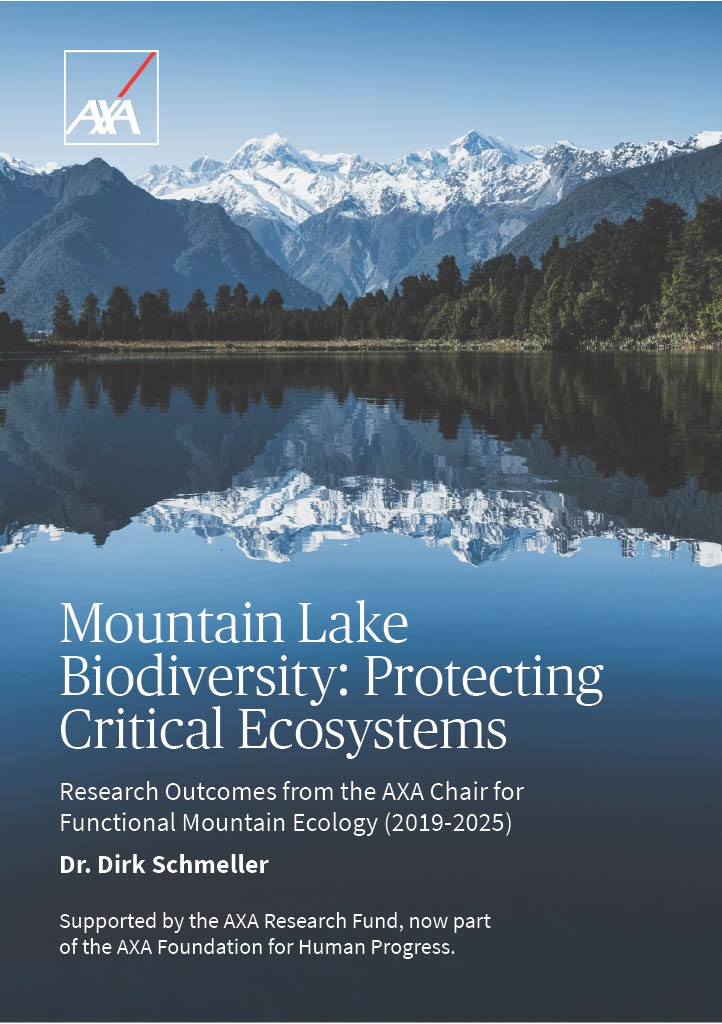
Mountain Lake Biodiversity: Protecting Critical Ecosystems
Click here to download the full report
Dirk
SCHMELLER
Institution
Institut National Polytechnique de Toulouse
Country
France
Nationality
German
Related articles
.little-card.png)

Climate Change
Terrestrial Biodiversity
Ice-sheet Melting
Sea-level Rise & Erosion
Mountains, Glaciers, Tundra & Permafrost
Climate Adaptation & Resilience
AXA Project
France
Under Antarctica — A Kite-Ski Science Expedition to Map Ice-Sheet Dynamics
Starting in November 2025, French glaciologist Heidi Sevestre and explorer Matthieu Tordeur will undertake a 3 month unprecedented kite-ski crossing... Read more

Heidi
SEVESTRE
Société des Explorateurs Français
Matthieu
TORDEUR
Société des Explorateurs Français
Climate Change
Finance, Investment & Risk Management
Societal Challenges
Climate Adaptation & Resilience
Insurance & Risk Management
Environmental Justice
Civil Society & Governance
AXA Project
Italy
AXA Research Lab on Climate Change, Risk and Justice
In response to three research questions: How can the private and financial sectors contribute to a just transition to a... Read more

Gianfranco
PELLEGRINO